
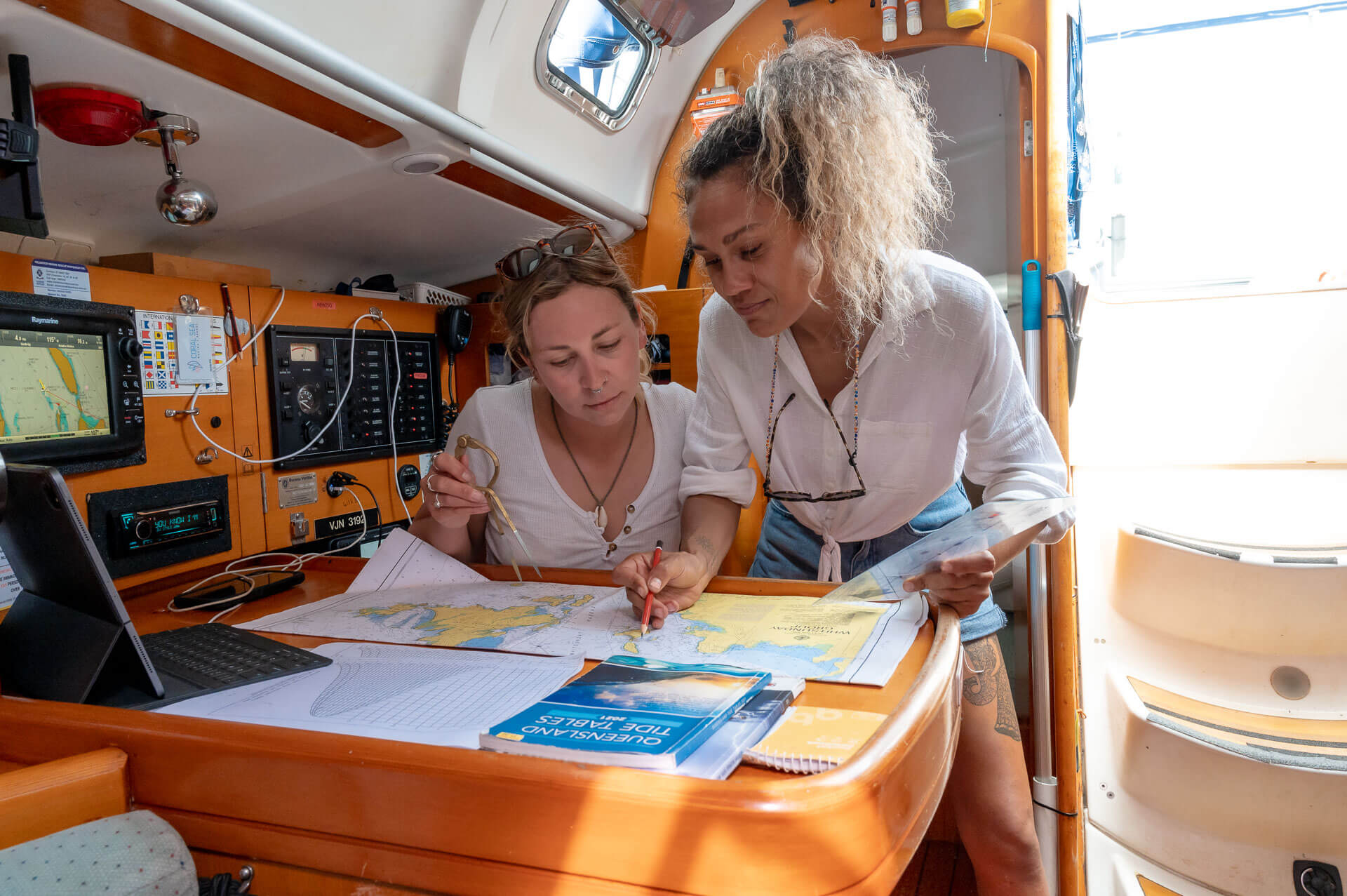


There is something wonderfully satisfying about knowing exactly where you are on the water — and knowing how to get where you want to go.
For many people new to sailing, navigation can initially seem complicated. Charts are covered in symbols and numbers, the compass seems to have a language of its own, and then there are tides, currents, bearings, waypoints and GPS.
But navigation doesn’t have to be intimidating.
At its heart, navigation is simply the process of understanding where you are, where you want to go, and what you need to consider along the way. And once those fundamentals start to make sense, navigation becomes one of the most rewarding parts of sailing.
Marine navigation is the art and science of determining your position and planning a safe route across the water. Unlike driving, there are no roads, lane markings or intersections telling you where to go. A sailor needs to understand the water around them and make decisions based on charts, landmarks, navigation marks, compass bearings, depth, tides, weather and the capabilities of the vessel. Modern yachts make this easier with GPS and electronic chartplotters, but good seamanship means understanding the principles behind the technology too. Because batteries can fail. Electronics can malfunction. Visibility can disappear. Your navigation skills shouldn’t disappear with them.
A nautical chart is essentially the sailor’s map.
Charts provide essential information about the waters you’re navigating, including:
Learning to read a chart is one of the first big steps towards becoming a confident navigator. And when you’re sailing somewhere as spectacular — and sometimes complex — as the Whitsundays, understanding what’s beneath and around your yacht is particularly important.
Every position on Earth can be described using latitude and longitude.
Latitude tells you how far north or south you are of the Equator.
Longitude tells you how far east or west you are of the Prime Meridian.
Together, they provide a precise geographic position. Your GPS can tell you your latitude and longitude almost instantly, but learning to understand these coordinates gives you a much better appreciation of exactly where you are on the chart.
The magnetic compass has been helping sailors find their way for centuries — and it remains an important piece of navigation equipment today.
A compass allows you to establish and maintain a direction, take bearings and help determine your position.
One of the most useful navigation skills is learning how to take a bearing.
A bearing is simply the direction of one object from your vessel, measured in degrees.
Take bearings to recognisable landmarks or navigation marks and you can begin building a picture of your position — rather than simply relying on a screen telling you where you are.
Before GPS, sailors still had to navigate.
One of the traditional techniques is dead reckoning, where you estimate your current position based on a previously known position, your course, speed and the time travelled.
Of course, wind and current can affect where the yacht actually ends up.
That’s why sailors may also use an estimated position, taking into account factors such as tide, current and other influences on the vessel.
These techniques remain valuable today because they encourage you to think about your vessel’s movement rather than simply follow a digital position.
Modern navigation systems are fantastic.
With GPS and electronic chartplotters, you can see your position, plan routes, monitor your progress and navigate with remarkable accuracy.
But there is an important distinction:
Using navigation technology isn’t the same as understanding navigation.
A confident skipper should be able to look at a chart and understand the route, identify hazards, recognise navigation marks and make sensible decisions if the electronics suddenly become unavailable.
The best approach is not traditional navigation versus technology.
It’s traditional navigation supported by modern technology.
Knowing where you are is only part of navigation.
You also need to understand what the water is doing.
Tides can significantly affect depth, particularly when entering shallow areas, anchorages and channels. Currents can also push a yacht away from its intended track.
This is known as set and drift.
Your planned course might point directly towards your destination, but the current could be quietly moving you sideways.
Good navigation takes these factors into account before you set off — rather than discovering them halfway there.
Night sailing adds another dimension to navigation.
Landmarks become harder to identify, visual references change and navigation lights become increasingly important.
A sailor needs to understand the meaning of different navigation lights and be able to identify vessels, navigation marks and hazards in darkness.
This is one reason night navigation is such a valuable skill for sailors progressing beyond basic sailing.
It teaches you to combine multiple sources of information rather than relying on what you can simply see around you.
Perhaps the most important part of navigation actually happens before you leave the marina.
A good skipper considers:
Where am I starting?
Where am I going?
What hazards are between the two?
What will the tide and current be doing?
What weather conditions can I expect?
Are there suitable alternatives if conditions change?
What are the limitations of my vessel and crew?
This is passage planning — and it’s an essential part of becoming a competent skipper.
Navigation is one of the areas where you can really see the progression through RYA training.
With RYA Competent Crew, you begin developing an understanding of the yacht and your role as part of the crew.
With RYA Day Skipper, navigation becomes much more central to your responsibilities as you begin planning and executing passages.
As you progress towards RYA Coastal Skipper, your navigation skills become increasingly sophisticated, including more advanced passage planning and navigating in more demanding conditions. The goal isn’t simply to memorise navigation terminology. It’s to develop the ability to look at a chart, understand your surroundings, assess the conditions and make good decisions.
The Whitsundays provide an incredible environment in which to develop these skills.
With hundreds of islands, reefs, channels, anchorages, changing depths, tides and weather conditions, there is plenty for a sailor to learn.
And there’s something particularly rewarding about putting the navigation theory into practice.
You study the chart.
You plan your route.
You check the weather and tides.
You leave the marina.
And then you watch the chartplotter, compass, coastline and navigation marks come together to confirm that you’re exactly where you expected to be.
That’s when navigation starts to become less about numbers and more about confidence.
Technology will continue to evolve. Chartplotters will become more sophisticated and GPS will become even more accurate. But the most important navigation tool on any yacht will always be the person making the decisions. Good navigation isn’t about knowing where you are. It’s about knowing where you are going, understanding what lies between you and your destination, and having the confidence to get there safely. And that is a skill every sailor can continue developing, mile after mile.
Keep exploring the Whitsundays, sailing, seamanship and life on the water.



Take your sailing further with Mainstay Sailing.


Check out our Youtube videos!

Coral Sea Marina
Shingley Drive
Airlie Beach
QLD 4802
AUSTRALIA
Postal address
PO Box 890
Cannonvale
QLD 4802
AUSTRALIA
Lat: 20° 16′ South
Long: 148° 43′ East
Phone: +61402429152

