Sailing and Sea Safety & Survival School Operating Procedure
INTRODUCTION
Mainstay Sailing will strive to create a no blame culture and do everything reasonably practicable to ensure the safety of all persons.
Duty of Care
Duty of care is a legal obligation imposed on an individual requiring that they take reasonable care (to themselves as well as others) while performing any acts that could impose foreseeable harm on others.
CONSULTATION
Mainstay Sailing will consult with all interested parties in the interests of safety…
SAFETY CHECKS
Safety checks are to be undertaken on all applicable equipment:
INDUCTION TRAINING
Induction training is to incorporate the following items:
Please refer to the Induction training manual
All new Instructors or other staff members are to sign the bottom of the induction checklist
SUPERVISION OF ACTIVITIES
The training centre principal is ultimately responsible for ensuring the adequate supervision of all training activities…
HEALTH AND SAFETY RULES
- Housekeeping
- PPE use
- Maintenance procedures
- Accident reporting
- First Aid attention
- Fire prevention
- Electrical equipment
- Smoking, Alcohol, Drugs
- Horseplay & misuse of equipment
- Operating power driven vessels
HAZARD IDENTIFICATION
A Hazard is anything that can cause harm to people, property or the environment
Mainstay Sailing shall consider the following types of hazard:
- Biological
- Mechanical/electrical
- Psychological
- Physical
- Chemical
Mainstay Sailing may use the following techniques to identify hazards:
- Consultation
- Inspections and Hazard Surveys
- Examination of other relevant information
- Injury/illness records
- Audits
- Incident/accident investigations
- Health & environment monitoring
- Complaints
- Observations
HAZARDS IDENTIFIED
The attached Hazard identification and risk rating spreadsheet is to be used to help identify and manage the risks.
RISK ASSESSMENT
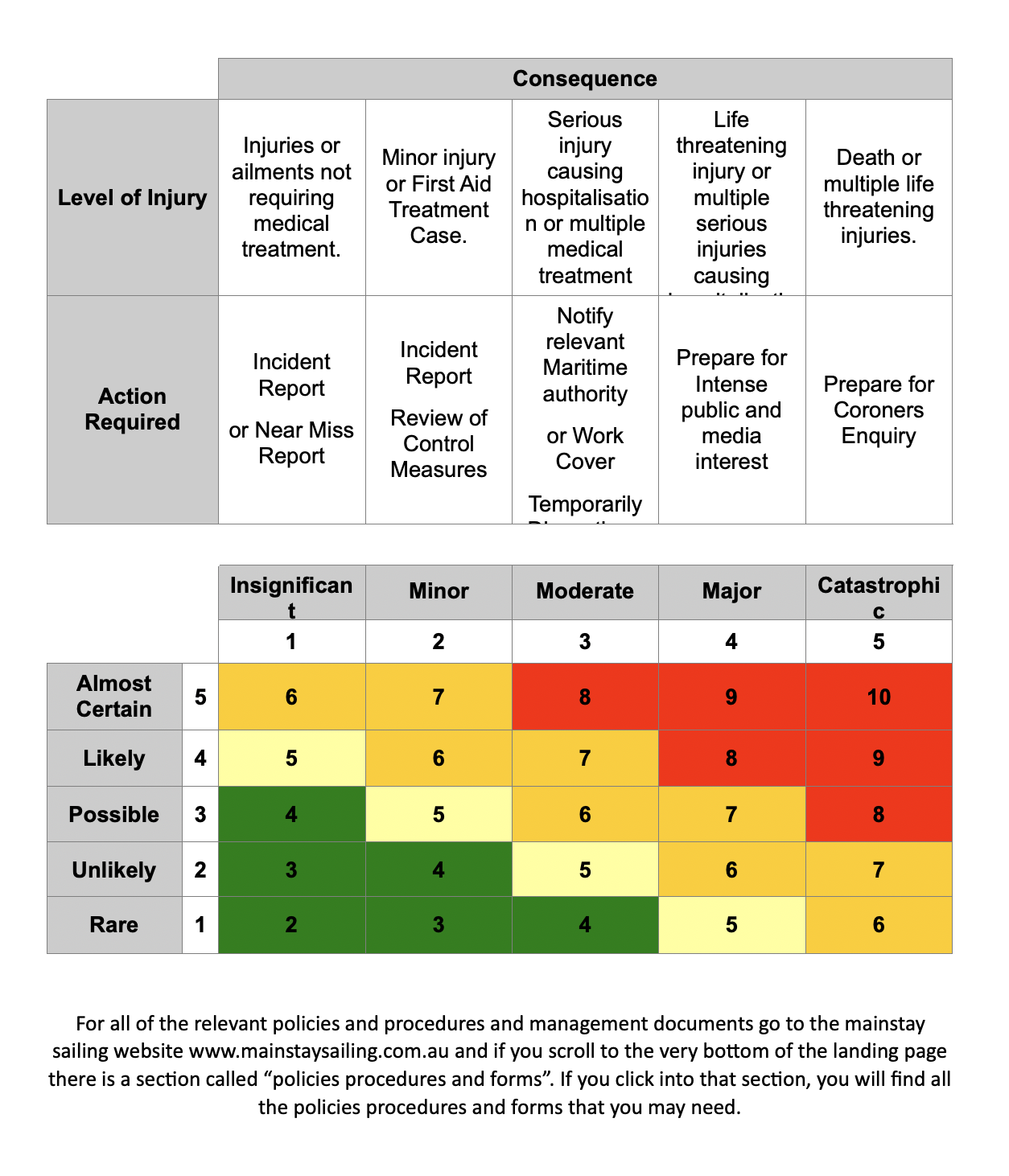
The following matrix shall be used to prioritise the implementation of control measures. In our attached hazard forms, we have included a frequency factor to help weight the risk score.
The frequency is how often a person is likely to be exposed to the hazard over a relative time scale (per day, per course) This allows us to focus more on the higher priority items.